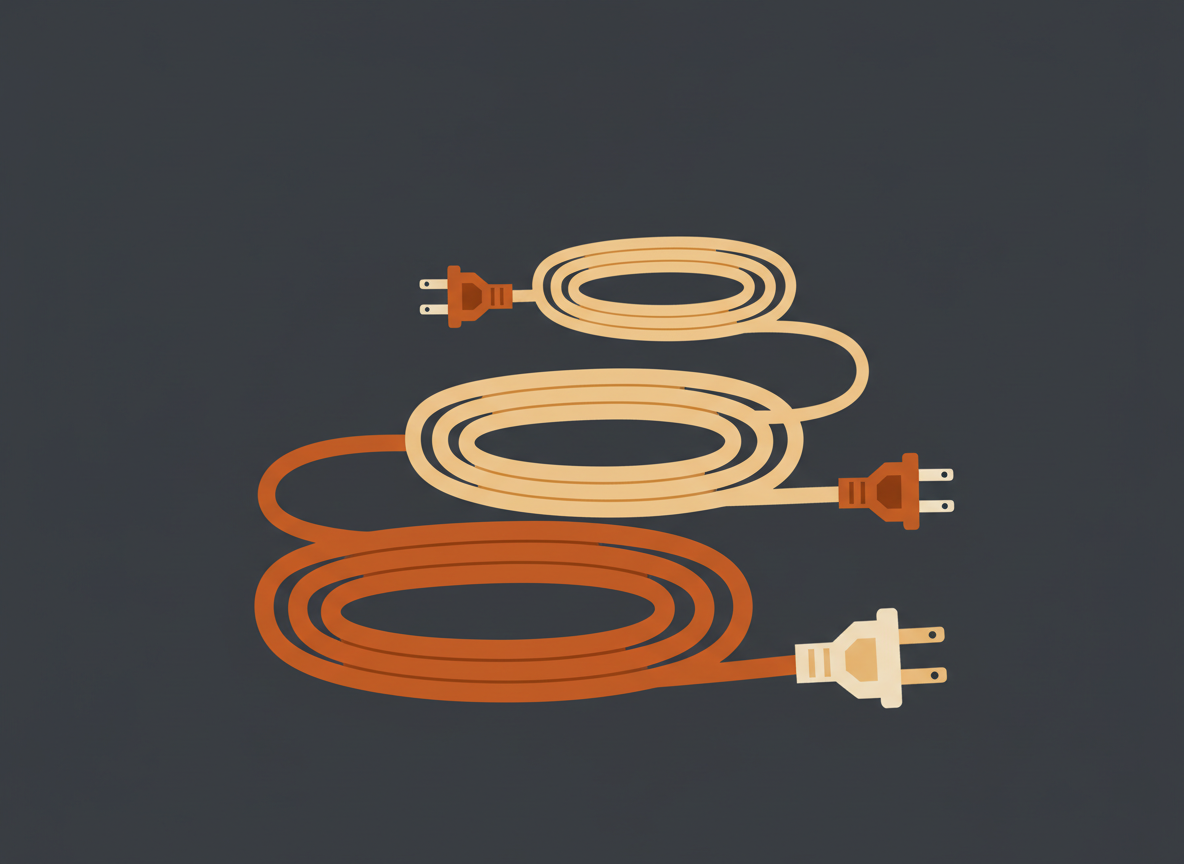
Extension cords look interchangeable, but a thin cord feeding a power-hungry tool can overheat. Choosing the right one takes about a minute once you know what to look for.
Read the cord’s rating
Every cord has a label or tag showing its wire gauge, its amp or watt rating and whether it’s rated for indoor or outdoor use. The rule is simple: the cord’s rating must be at least as high as the total load you plug into it.
Gauge: lower number, thicker wire
Like house wiring, cords use the AWG system, so a 12-gauge cord is thicker and carries more current than a 16-gauge cord. As a general guide:
- 16 gauge (light duty): lamps, phone chargers, small electronics.
- 14 gauge (medium duty): hedge trimmers, drills, some power tools.
- 12 or 10 gauge (heavy duty): circular saws, air compressors, high-draw tools, long outdoor runs.
Always check the specific rating on the cord label, since it depends on the gauge and the length.
Length matters
Longer cords lose more voltage, the same effect explained in our guide to voltage drop. For long runs or motor-driven tools, step up to a thicker gauge, and use the shortest cord that reaches.
Check the tool’s power draw
Find the amps or watts on the tool’s nameplate. If the label shows watts, divide by 120 to get amps on a standard U.S. outlet. Add up everything you’ll plug in at once and compare it with the cord’s rating. Our guide to watts and kilowatt-hours explains the conversions.
Safety rules
- Don’t use extension cords for space heaters, window air conditioners or other high-power appliances unless the manufacturer explicitly allows it; plug them directly into the wall.
- Use outdoor-rated cords outside and plug them into GFCI-protected outlets. See GFCI vs. AFCI.
- Never run cords under rugs or through doorways where they can be pinched.
- Don’t chain several cords together.
- Uncoil cords fully when running heavy loads, and replace any cord that is damaged, cut or warm to the touch.
- Look for a mark from a recognized testing laboratory.
If you rely on an extension cord every day in the same spot, that’s a sign you need a permanent outlet. A licensed electrician can add one safely.