If you’re cooling a single room or a home without ductwork, you’ll probably choose between three options: a window unit, a portable air conditioner or a ductless mini-split. Each has clear strengths.
Window air conditioners
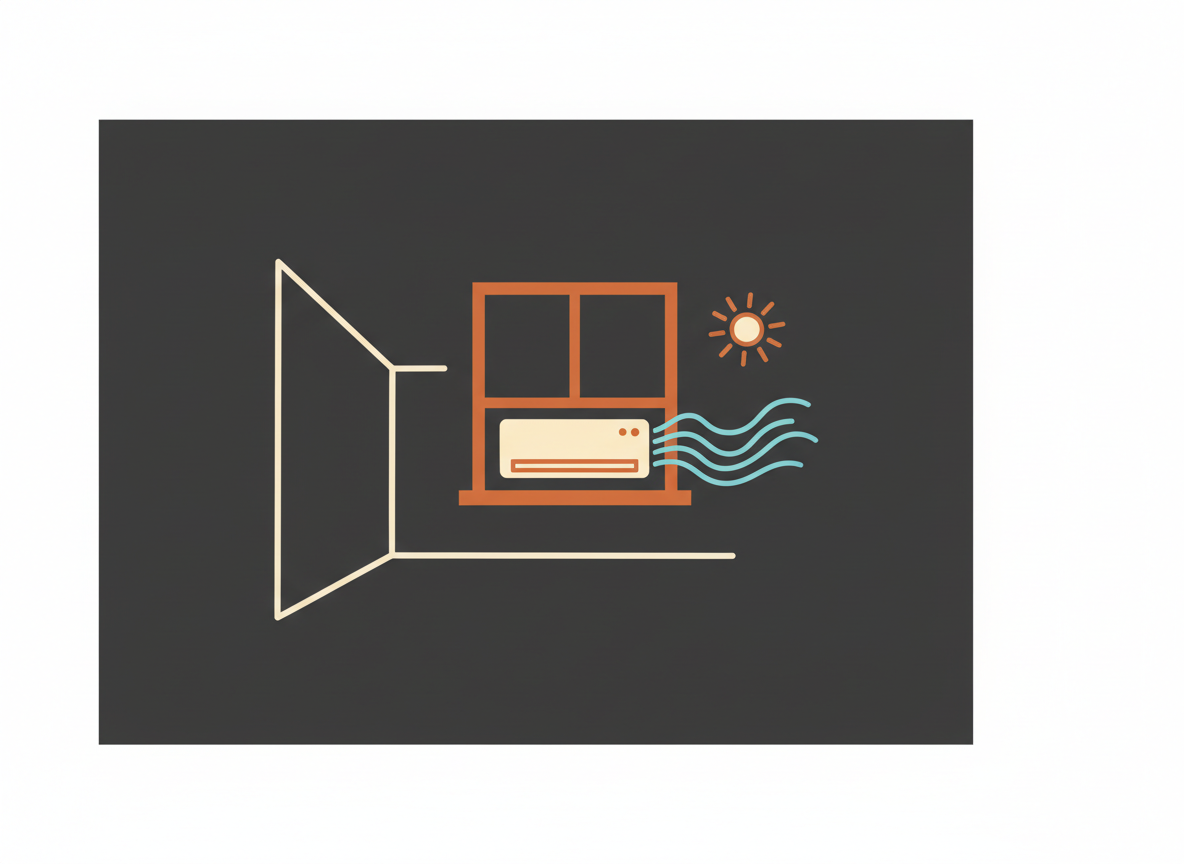
A self-contained box that sits in a window, with the hot side outside. Window units are usually the cheapest way to cool a room and, for the price, they’re efficient because all the heat-producing parts stay outdoors.
- Pros: low cost, good efficiency, easy DIY install.
- Cons: blocks part of the window, can be noisy, not allowed in some buildings, must be supported securely.
Portable air conditioners
A unit on wheels that sits in the room and vents hot air through a hose to a window kit. Portables are the easiest to move and suit windows that can’t take a window unit, such as casement or sliding windows.
- Pros: flexible placement, simple setup, works with more window types.
- Cons: usually less efficient than a window unit of similar rating, since the machine and hose sit inside the room; takes floor space; can be louder indoors.
Dual-hose portables tend to perform better than single-hose models because they don’t pull already-cooled room air outside.
Ductless mini-splits
An indoor head on the wall connects through a small hole to an outdoor compressor. Most are heat pumps, so they heat as well as cool. They’re the most efficient and quietest option, and one outdoor unit can serve several rooms.
- Pros: very efficient, quiet, heats and cools, keeps windows free.
- Cons: highest upfront cost; usually needs professional installation, including refrigerant work and often a dedicated circuit.
Which one is right for you?
- Renting, tight budget, standard window: a window unit.
- Window type won’t fit a unit, or you need to move it: a portable, ideally dual-hose.
- You own the home and want year-round comfort and lower running costs: a mini-split.
Get the size right first
Whatever type you choose, the capacity has to match the room. Use our BTU Calculator and read how many BTU you need. Then estimate running costs from the unit’s wattage with the Electricity Cost Calculator.