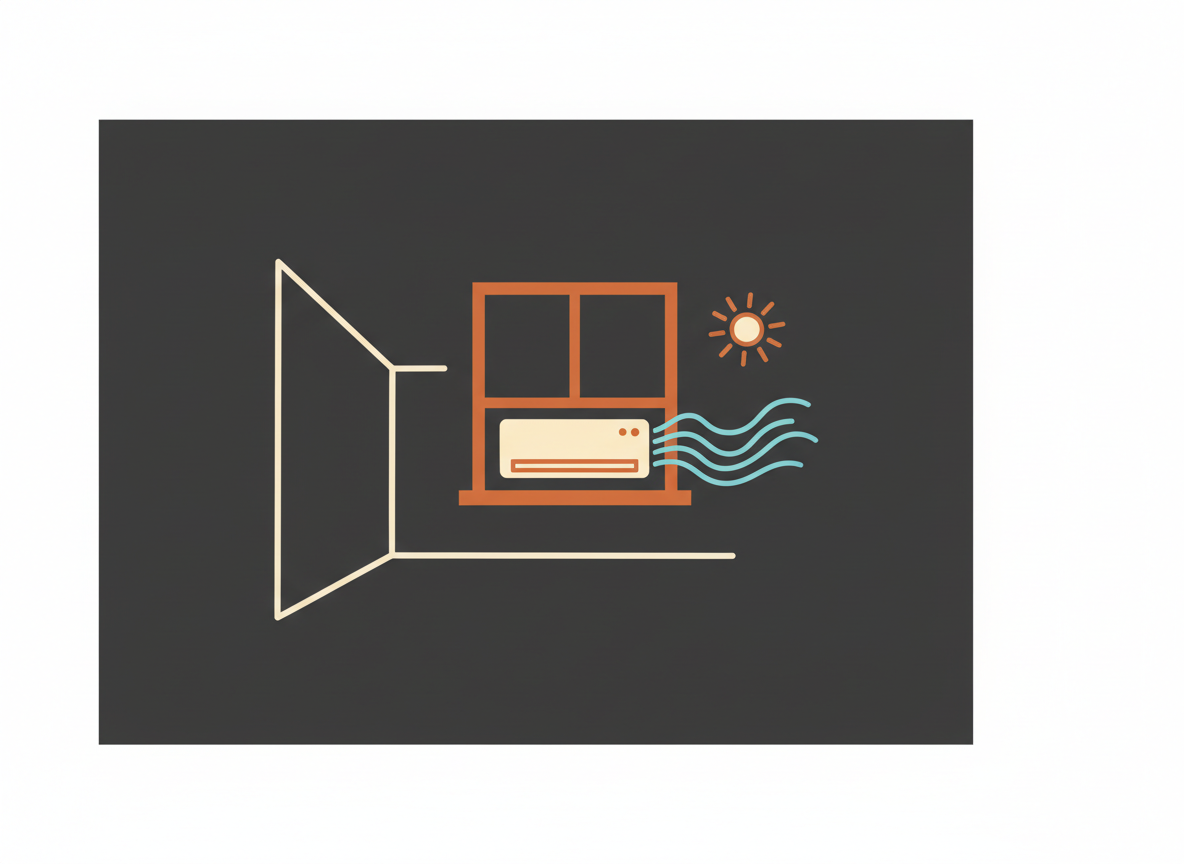
Buying an air conditioner that’s the wrong size is one of the most common cooling mistakes. Too small and it never catches up on hot days. Too big and the room feels cold and clammy. Here’s how to get it right.
What BTU means
Air conditioners are rated in BTUs (British Thermal Units) per hour: how much heat they can remove from a room in an hour. Larger rooms gain more heat, so they need more BTUs. In the HVAC trade, 12,000 BTU per hour is called one “ton” of cooling.
Start with square footage
Measure the room’s length and width in feet and multiply them. Then use common room air conditioner sizing guidelines as a starting point:
| Room size (sq ft) | Cooling capacity (BTU/hour) |
|---|---|
| 100–150 | 5,000 |
| 150–250 | 6,000 |
| 250–300 | 7,000 |
| 300–350 | 8,000 |
| 350–400 | 9,000 |
| 400–450 | 10,000 |
| 450–550 | 12,000 |
| 550–700 | 14,000 |
| 700–1,000 | 18,000 |
Then adjust for real conditions
- Heavily shaded room: reduce capacity by about 10%.
- Very sunny room: increase capacity by about 10%.
- More than two people regularly in the room: add about 600 BTU per extra person.
- Kitchen: add about 4,000 BTU for cooking heat.
Our free BTU Calculator applies all of these for you.
Why bigger isn’t better
Air conditioners do two jobs: they lower the temperature and remove humidity. An oversized unit cools the air so fast that it shuts off before it has removed much moisture. The result is a room that’s cold but damp, plus more on-off cycling that wastes energy and wears out the compressor. Choose the size closest to your calculated need.
Other factors that change the answer
- Ceiling height: the guidelines assume about 8 feet. Higher ceilings mean more air to cool.
- Insulation and windows: poorly insulated rooms and large west-facing windows gain more heat.
- Climate: very hot regions may need a little more capacity.
- Open floor plans: if the room opens onto others, you’re cooling a larger space than it looks.
Check the electrical side
Smaller window units usually plug into a standard 120-volt outlet. Larger units may need a dedicated circuit or a 240-volt outlet. Read the unit’s label and manual before buying, and avoid running an air conditioner on an extension cord. If you need a new circuit, our wire size guide explains the basics, and a licensed electrician can install it safely.
Whole-house systems are different
These guidelines are for single rooms. Central air and heat pumps for a whole house should be sized by an HVAC professional using a full load calculation, often called Manual J, which accounts for insulation, windows, orientation and local climate.
Key takeaways
- Start from square footage, then adjust for sun, people and kitchens.
- Oversizing leaves rooms cold and damp; buy the closest size.
- Check the outlet or circuit the unit needs before you buy.