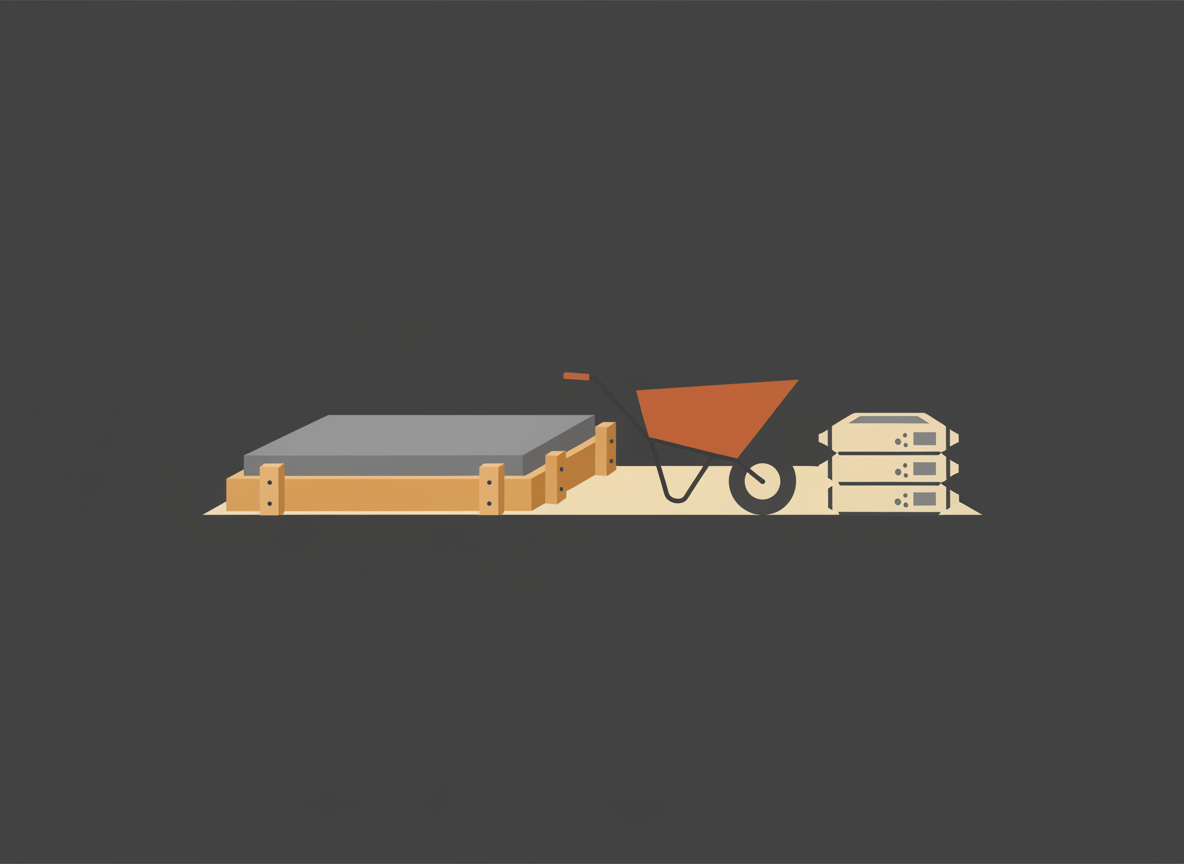
Ordering too little concrete can leave a slab with a weak seam where the second batch meets the first. Ordering far too much wastes money. Here’s how to calculate the right amount for a slab, patio or pad.
Step 1: Calculate the volume
Measure length and width in feet and thickness in inches. Convert the thickness to feet by dividing by 12, then multiply:
cubic feet = length × width × (thickness in inches ÷ 12)
cubic yards = cubic feet ÷ 27

Example: 10 × 10 ft slab, 4 in thick
10 × 10 × (4 ÷ 12) = 33.3 cubic feet = 1.23 cubic yards
Step 2: Add extra
Ground is never perfectly flat, forms can bow slightly, and some concrete is always lost. Add about 5 to 10%. In the example, 10% extra brings the total to about 36.7 cubic feet, or roughly 1.36 cubic yards.
Step 3: Convert to bags
Premixed concrete bags list their yield on the label. Typical yields are about 0.60 cubic feet for an 80 lb bag, 0.45 for a 60 lb bag and 0.30 for a 40 lb bag. For the example slab, that’s about 62 bags of 80 lb, which is a lot of mixing.
Our Concrete Calculator works out cubic yards and bag counts for you.
Bags or ready-mix?
- Bags suit small pads, post footings, steps and repairs.
- A ready-mix truck makes sense once you need around a cubic yard or more and want the slab poured in one go. Ask suppliers about minimum orders and short-load fees.
- Rental mixers sit in between: faster than hand mixing for medium jobs.
Getting a good slab
- Prepare a compacted gravel base, often around 4 inches, for drainage and support.
- Set level, well-braced forms and add a slight slope away from buildings.
- Add reinforcement such as wire mesh or rebar where needed.
- Cut control joints so cracks form in straight lines.
- Keep the slab damp while it cures over the first several days.
Structural slabs, footings and driveways may have local code requirements for thickness and reinforcement. Check with your building department before you pour.
Key takeaways
- Cubic yards = length × width × thickness (ft) ÷ 27.
- Add 5–10% extra.
- Bags for small jobs; ready-mix for larger slabs.