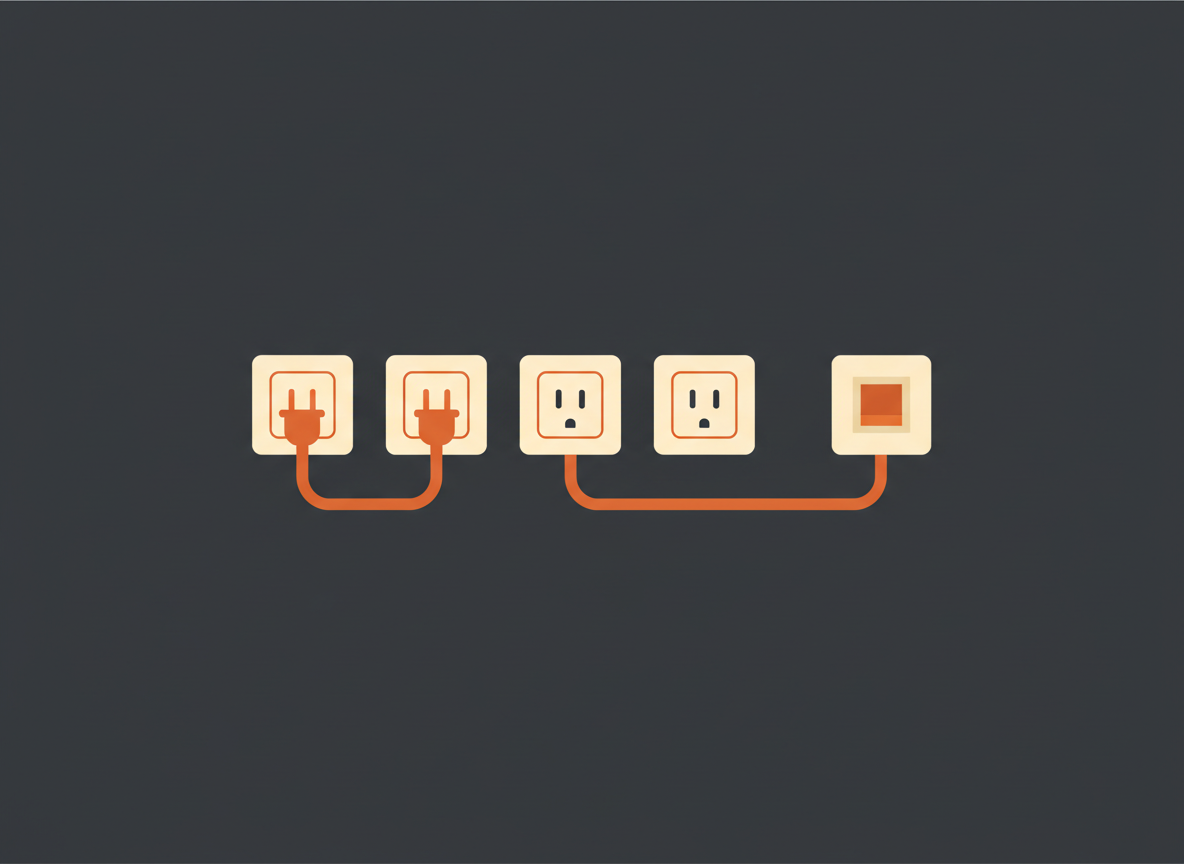
It’s one of the most common electrical questions, and the answer surprises many people: for general-purpose circuits in homes, the National Electrical Code doesn’t set a fixed maximum number of outlets. What matters is how much power you actually use at once.
The real limit is the load
A circuit can deliver a certain amount of power before the breaker trips:
| Circuit | Maximum | Comfortable for long-running loads (80%) |
|---|---|---|
| 15 A, 120 V | 1,800 W | 1,440 W |
| 20 A, 120 V | 2,400 W | 1,920 W |
Ten outlets that power lamps and phone chargers are no problem. Two outlets running a space heater and a hair dryer at the same time will trip a 15-amp breaker. Find out what your devices draw with our Electricity Cost Calculator and the guide to watts and kilowatt-hours.
Rules of thumb electricians use
Even though there’s no residential cap, many electricians plan general-purpose circuits with a modest number of outlets, often around 8 to 10 on a 15-amp circuit and somewhat more on a 20-amp circuit, depending on how the rooms will be used. (Commercial buildings do have a calculation-based limit per outlet, but it doesn’t apply to general outlets in dwellings.)
Rooms that need dedicated circuits
The code requires certain areas to have their own 20-amp circuits, typically including:
- Kitchen countertops: at least two 20-amp small-appliance circuits.
- Bathrooms: a 20-amp circuit for the bathroom outlets.
- Laundry: a 20-amp circuit for the laundry outlets.
Large fixed appliances such as dishwashers, disposals, microwaves over the range and furnaces usually get individual circuits too, per the manufacturer’s instructions and local code. Use 12 AWG copper wire on 20-amp circuits; see What Size Wire Do I Need?
Signs a circuit is overloaded
- The breaker trips when certain appliances run together.
- Lights dim when something starts.
- Outlets or plugs feel warm.
Spread high-power devices across different circuits, and if you regularly run out of capacity, have a licensed electrician add a circuit. Our guide DIY or Call an Electrician? lists the warning signs that need a professional.